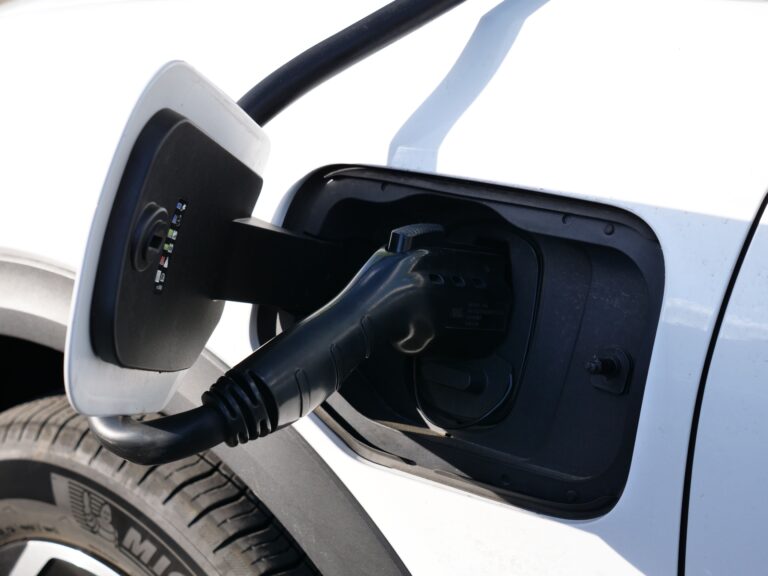
You bought the car first. Now you are standing in the garage under your building in Palm Beach Gardens, looking at a deeded space a long way from the nearest electrical room, and the property manager has already told you the board does not allow chargers.
That answer is usually wrong, at least as a flat no. Florida law has covered condominium charging since 2018, and it puts the decision much closer to the unit owner than most boards realize.
What Florida Statute 718.113(8) actually says
Section 718.113(8) of the Florida Statutes lives inside the Condominium Act. It says a declaration of condominium or a restrictive covenant may not be enforced so as to prohibit a unit owner from installing an electric vehicle charging station within the boundaries of that owner’s limited common element or exclusively designated parking area. The statute also states the installation is not a material alteration of the common elements, which removes the usual argument that a vote of the membership has to happen first. You can read the section yourself on the Florida Senate statute page.
Three practical points fall out of that text. The electricity has to be separately metered or metered by an embedded meter inside the charging station, and the unit owner pays for it. The installation cannot cause irreparable damage to the condominium property. And installation, operation, maintenance and repair are the owner’s responsibility, not the association’s.
One caveat. That is the Condominium Act. If your community is a homeowners association under Chapter 720 instead, the same language does not follow you, so read your own governing documents first.
What the board can still require
A board cannot say no. A board can absolutely say how, and a well run association in Jupiter, Stuart or Boca Raton will use every bit of that room.
- Architectural standards. Where the conduit runs, how it is finished, how the wall connector is mounted and what it looks like from the drive aisle.
- A licensed and registered firm. The statute lets the association insist the work be done by a contractor familiar with installing and removing charging stations.
- Insurance. A certificate naming the association as an additional insured, which the statute expects within fourteen days after the association approves the request.
- A permit and a passed inspection. Palm Beach County, Martin County and St Lucie County all want an electrical permit for a hardwired charger. That inspection record is what protects both you and the association five years from now.
Bring all four to the first meeting instead of waiting to be asked.
The electrical reality of a condo garage
Florida is on the Florida Building Code, Eighth Edition, and Chapter 27 of that code adopts NFPA 70 by reference, so the book your inspector is holding is the 2020 National Electrical Code with Florida amendments layered on top. Article 625 governs the charger itself: the branch circuit, overcurrent protection sized for a continuous load, and the equipment. Charging equipment is treated as a continuous load, so the circuit and the load calculation are sized at 125 percent of the charger nameplate rating, and in a 1970s or 1980s building in North Palm Beach or Lake Worth that is often the number that ends the conversation. The 2023 National Electrical Code adds a dedicated calculation for charging equipment in Section 220.57, at 7,200 volt-amperes or the nameplate rating, whichever is larger, but Florida does not pick that edition up until the Ninth Edition of the Florida Building Code takes effect on December 31, 2026.
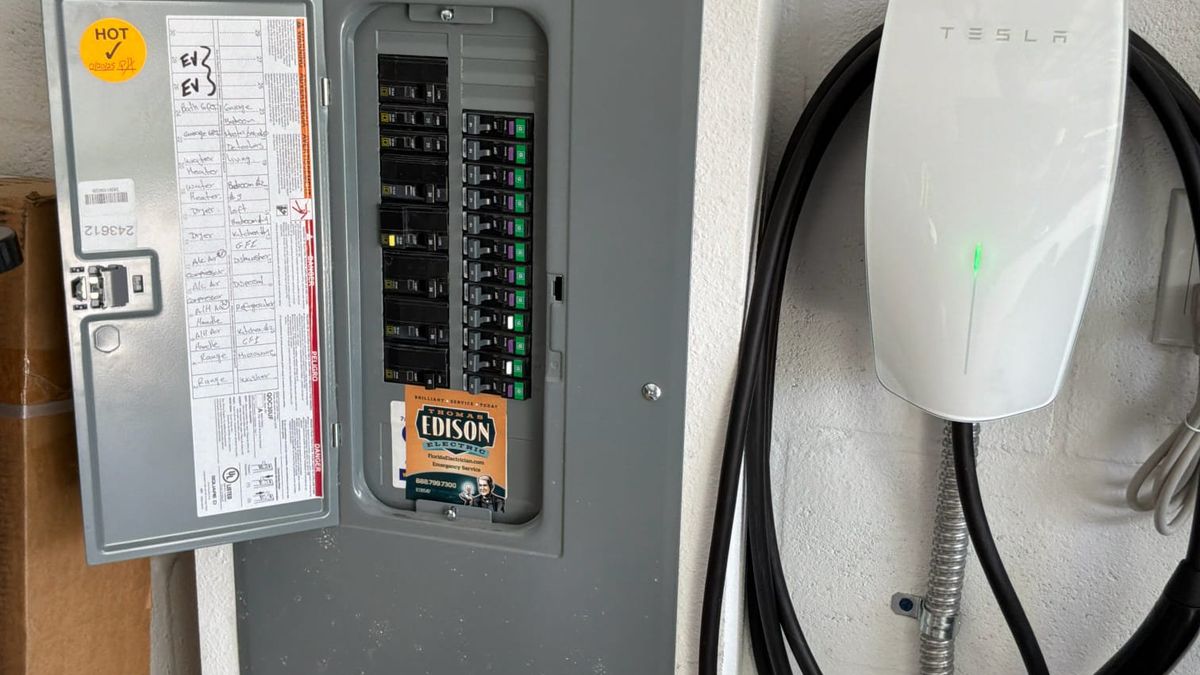
If the unit panel is full, or the service will not carry another large continuous load, an electrical panel upgrade becomes part of the project rather than an afterthought. Sometimes it is not needed at all. Most wall connectors can be commissioned at a lower continuous current, and the code recognizes energy management systems that back the charger off when the air handler and the water heater are both pulling. A car that sits from six at night until seven in the morning does not need the biggest circuit in the building, only one that finishes by morning.
Getting power from the panel to the space
The run is usually the real work in a condominium. Deeded spaces are rarely next to the electrical room, so conduit ends up surface mounted along a block wall or a beam, and it has to be routed where it will not become the association’s problem later. Concrete block takes an anchor cleanly. A post tensioned parking deck does not, and drilling one without engineering guidance is how a small job turns into a large one. Where the conduit lands and whether it crosses another owner’s space are questions the board will ask, so answer them on paper before the meeting.
Salt air, lightning and storm season
Parking structures along the coast in North Palm Beach, Delray Beach and Jensen Beach are open on at least one side, and they breathe salt. Equipment that would last decades inland gives up at the terminations first. Enclosure rating and stainless hardware matter, and so does the wall you pick. A connector on the seaward face of an open deck ages very differently from one set twenty feet inside.
Lightning is the other Florida variable. This stretch of the state sees more cloud to ground strikes than almost anywhere in the country, and a charger is electronics living on a 240 volt circuit. Surge protection at the panel covers the charger, the air handler board and everything else on the service. Before a named storm, unplug the vehicle and leave it unplugged until FPL has finished restoring the feeder, because restoration is rarely one clean event. FPL publishes what to expect on its storm center.
What to hand the board
A complete request is short. A load calculation for your unit, a photo of the panel, the make and model of the charger with its nameplate rating, a simple drawing of the conduit route, the installing contractor’s license and insurance, and a line confirming the electricity will be metered inside the charging station and billed to you. That packet answers the statute and the association’s legitimate concerns in one pass, and it is much harder to table than a verbal request.
If a board still refuses, you have a written record and a statute behind you, and that is the point where a Florida community association attorney earns the call.
We wire chargers in condominium and townhome garages from Jupiter and Tequesta through Palm Beach Gardens, West Palm Beach and Wellington, and north into Palm City, Hobe Sound and Port St Lucie. If you want the circuit sized and the route drawn before you walk into the meeting, start with EV charger installation or get in touch. Someone answers around the clock.