The renewal notice shows up, the carrier asks for a 4-point inspection, and two weeks later you are holding a report with three words on the electrical page that change your month: aluminum branch wiring. Nothing in the house has ever sparked. No breaker has tripped in years. The policy is conditional anyway.
That call comes in from Lake Worth, Boynton Beach and Greenacres most weeks, with Delray Beach, Royal Palm Beach and the older pockets of Stuart right behind. The report is not wrong, and it is not a reason to panic. It does mean you have a decision to make before the renewal date.
Why the 4-point keeps landing on your wiring
Citizens Property Insurance requires a four point inspection on property owner, dwelling and mobile home applications for homes more than 20 years old, and most private carriers writing in Palm Beach, Martin and St Lucie counties do the same. The inspector documents the age, type and condition of four systems: roof, plumbing, HVAC and electrical.
Aluminum branch wiring sits near the top of the electrical page because of when it went into the walls. Small gauge aluminum was used for 15 and 20 amp circuits in single family construction from roughly 1965 into the mid 1970s, which is exactly the stretch that built out a large share of Lake Worth, Boynton Beach, Greenacres and western Delray Beach. If your house went up in that window and has never been rewired, there is a real chance it is in there.
One clarification saves some worry. The heavy aluminum conductors running from the meter to the panel are a different animal and are still installed new today. Nobody is flagging those. The concern is the small branch circuits feeding your receptacles, switches and light boxes.
What actually goes wrong, and where
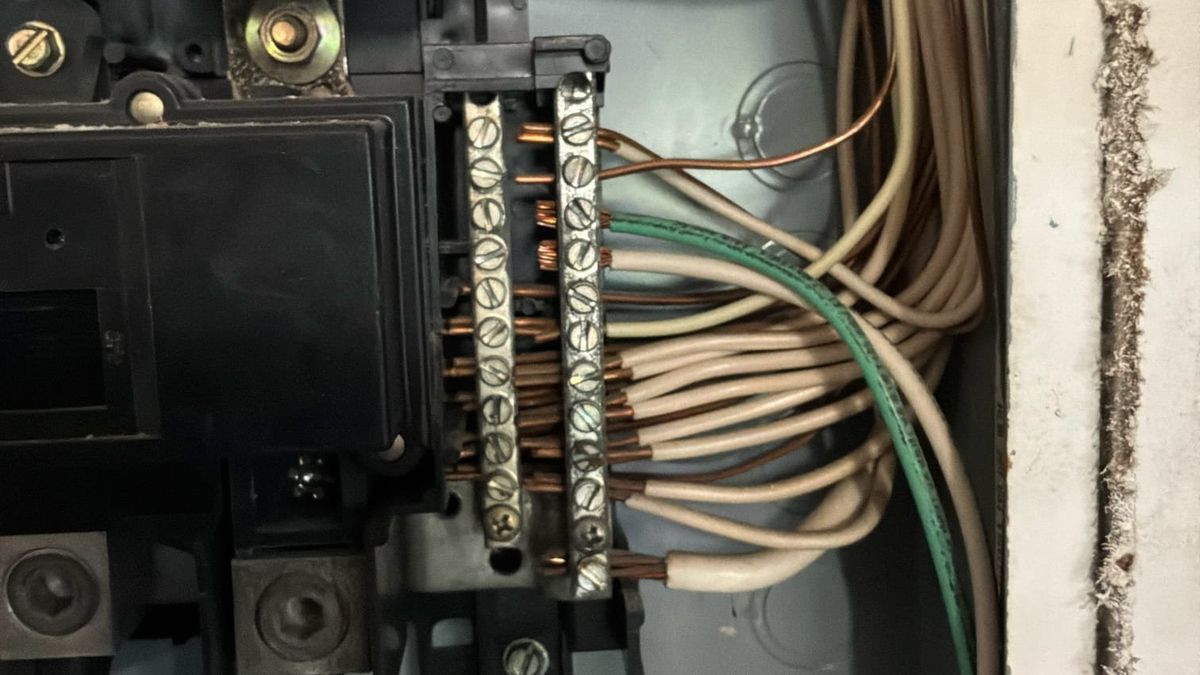
Aluminum expands and contracts more than copper under load and keeps a little of that movement every cycle, so over thirty or forty years the connection under a screw terminal works itself loose. Aluminum also grows a surface oxide that resists current, and landing it on a brass or plated steel screw adds a dissimilar metal joint on top of that. Loose plus resistive equals heat, and heat at a connection is how fires start.
South Florida leans on every one of those weak points. Attic temperatures above a Lake Worth garage in August, air conditioning that runs nine or ten months a year, humidity that never fully lets go. Closer to the water in Jupiter, Hobe Sound and Jensen Beach, salt air works into boxes and fixtures and speeds the corrosion along.
Almost none of this happens mid run. The trouble lives at the ends, which is why it shows up as small symptoms that are easy to explain away:
- A cover plate, dimmer or switch that feels warm to the touch
- A receptacle that quits, then works again a day later
- Lights that dip harder than they used to when the air handler starts
- A faint burning or fishy smell near an outlet
- Half a bedroom dead while the breaker is still on
If any of that sounds familiar, stop using the circuit and get eyes on it. We answer and dispatch 24/7, because a warm receptacle at nine at night is not something to sleep on.
What counts as a real repair
This is where well meaning repairs go sideways. The U.S. Consumer Product Safety Commission publishes Repairing Aluminum Wiring, publication 516, and it recognizes a short list of permanent fixes: replacing the branch circuits with copper, the COPALUM crimp method, and the AlumiConn connector as an accepted alternative. Ordinary twist on wire connectors are not on that list, whatever the color.
There is a second piece people miss. A receptacle or switch making direct contact with aluminum conductors has to be built for it and marked CO/ALR, which is spelled out in Article 406.3(C) of the National Electrical Code, adopted by reference in Chapter 27 of the Florida Building Code. Swapping tired outlets for standard off the shelf devices on an aluminum circuit makes things worse, and a good inspector looks for it.
Whether the right answer is a full rewire or a documented connector repair at every device depends on how many circuits are involved, what shape the panel is in, and what your carrier will accept. That gets sorted during an electrical safety inspection, before anyone opens a wall.
What we find in Palm Beach and Treasure Coast homes
First, the wiring is rarely the only item on the report. Houses of that vintage often still carry their original panel, and several of those brands have a reputation of their own with underwriters. Fixing the branch circuits while leaving a tired panel in place usually does not close the file, so an electrical panel upgrade and the wiring work tend to get planned as one project.
Second, concrete block construction is friendlier to this work than homeowners expect. In plenty of CBS houses across Boynton Beach, Wellington and Palm Beach Gardens the branch circuits drop from the attic through conduit inside the furred out walls, so new conductors can often be pulled through the raceway that is already there instead of cutting into block. Frame walls and ceilings still need access openings, but the job is usually less invasive than the same work up north.
Seasonal homes are their own category. A Palm City or Hobe Sound house closed up from May through October sits in humidity with nobody there to notice a warm plate, so the first symptom is often a returning owner finding a dead circuit in November.
All of it is permitted and inspected through your building department, whether that is Lake Worth Beach, Boynton Beach, Martin County or St Lucie County. Ask for the permit number. Your carrier wants proof, and a permitted, inspected repair is the proof.
Handle it before the renewal date, not after
If your 4-point named aluminum branch wiring, the useful next step is not a price, it is an assessment. How many circuits are affected, what condition the terminations are in, whether the panel goes at the same time, and which repair path your carrier will sign off on.
Call Thomas Edison Electric and we will get an electrician to your Lake Worth, Boynton Beach or Stuart home, put the findings on paper, and walk you through the options for rewiring or repairing the branch circuits. Handle it on your calendar and you keep the choice. Wait for a non renewal letter and the calendar belongs to somebody else.