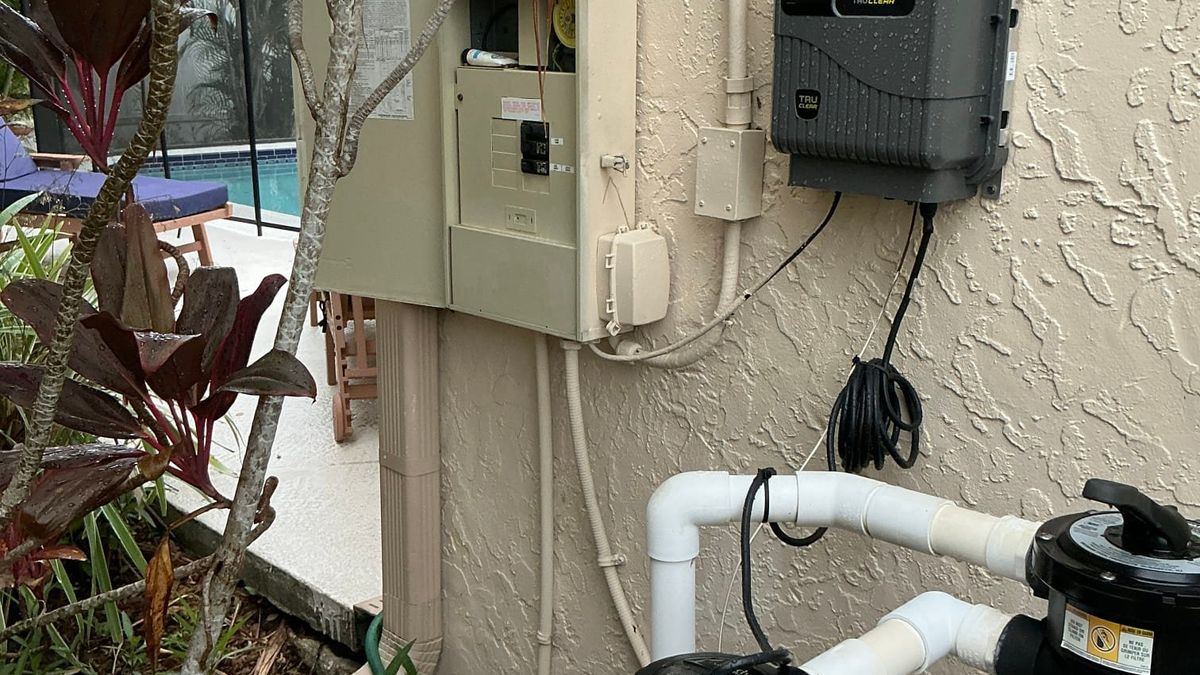
You grab the pool handrail on a July afternoon in Wellington and feel a faint buzz in your palm. Or a 4 point inspection in Port St Lucie comes back with a line about missing bonding at the equipment pad, and the carrier wants it corrected before writing the policy. Both land on the same part of the electrical code: Article 680 and its equipotential bonding rules, which govern every pool and spa in Palm Beach, Martin and St Lucie counties.
Bonding Is Not Grounding, and Around Water That Matters
Grounding gives fault current a road back to the source so a breaker trips and shuts the circuit down. Bonding does something else. It ties all the metal in and around the pool together so every piece sits at the same voltage at the same instant. Nothing trips. The point is that there is no difference in potential for a person to stand across.
That matters because of how a body behaves at a pool. Wet skin, bare feet, damp concrete deck, and electrical resistance drops through the floor. A voltage difference too small to notice anywhere else is enough to feel through a handrail, and a larger one can lock up muscles at the moment a swimmer needs to climb out. When someone says they felt a tingle on the ladder, we are not hunting a short circuit. We are hunting a broken bond.
What Article 680 Requires You to Tie Together
The National Electrical Code, published by the National Fire Protection Association as NFPA 70, is adopted into Florida law through the Florida Building Code. Section 680.26 calls for a bonding grid, joined with solid copper no smaller than 8 AWG, connecting:
- The conductive shell, meaning reinforcing steel in a gunite pool or a copper grid in a fiberglass or vinyl liner pool
- The perimeter surface out to three feet from the inside wall, paved or unpaved, so a paver deck and a poured deck are treated alike
- Metal fittings that penetrate the structure, including ladder cups and handrail anchors
- Pump motors and the metal parts of the circulating system, including heaters, filters and valve bodies
- Fixed metal within five feet of the water that is not separated by a permanent barrier
- The pool water itself, through a conductive surface of at least nine square inches in permanent contact with it
Notice what is not there. The bond does not run back to the panel, and driving a ground rod at the pad does not satisfy it. A grid complete everywhere except one lug is not a grid. It has a gap, and the gap is where voltage shows up.
Why Bonds Fail Faster Here Than Almost Anywhere
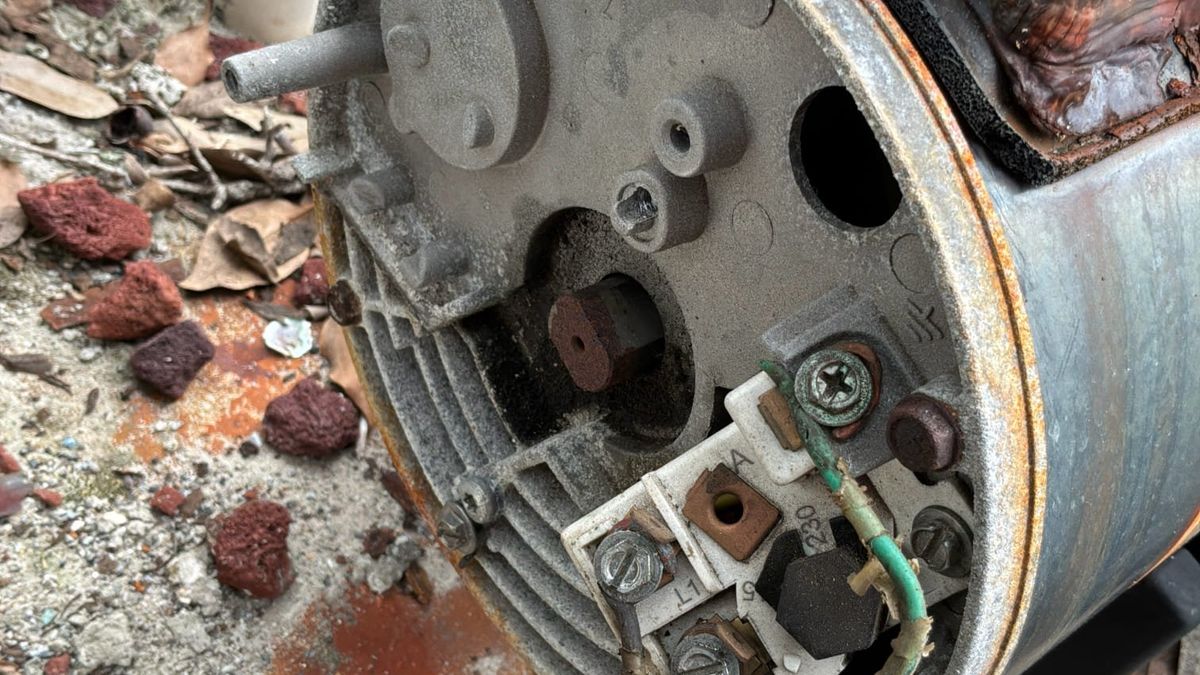
A grid installed correctly in 2004 can be useless in 2026 with nobody touching it. Salt air off the Atlantic works on equipment pads in Jupiter, Tequesta, Jensen Beach and Hobe Sound while you sleep. The bonding lug on a pump motor is the first casualty. Copper goes chalky green under a corroded screw, the connection turns high resistance, and it still looks perfectly attached. You learn about it through a meter or through your hand on the rail.
Weather adds to it. Afternoon storms flood pads poured a little too low, so gear sits in standing water for months. Florida takes more lightning than any other state, and a nearby strike does not have to reach your house to surge a pool controller or a salt chlorine generator. Conduit strapped to block walls in Royal Palm Beach rusts at the strap and pulls on the fitting.
Renovations Break More Bonds Than Storms Do
The most common broken grid we find in Delray Beach and Boca Raton has nothing to do with weather. Someone laid pavers over the original deck, or swapped a rusted ladder and never reattached the bond wire to the new anchor cups. Heaters, variable speed pumps and automation panels get changed out by pool contractors who do fine plumbing work and never carry the bond over. New metal at the pad without a new bond is our most frequent finding.
Spas, Hot Tubs and Screened Lanais
A packaged spa on a lanai in Palm Beach Gardens or Palm City ships with a bonding lug on the equipment compartment, and that lug is not decoration. If the spa sits near the pool, or on a deck the code counts as perimeter surface, it joins the same grid. The circuit also needs GFCI protection and a disconnect you can see from the equipment, set back from the water so nobody leans over the spa to kill power. Owners usually learn this backward, through a spa that trips every time it rains.
Screen enclosures matter because nearly every pool from North Palm Beach to Stuart has one. Aluminum framing is fixed metal, and when it stands inside that five foot zone with no permanent barrier between it and the water, it gets bonded like anything else. Cages are rebuilt after hurricanes far more often than bonding is rechecked, so a new enclosure is a good reason to verify the grid.
How the Grid Gets Checked, and What to Do Next
Testing is not guesswork. We check continuity between the pump, heater, salt cell, ladder cups, handrail anchors, deck perimeter and water bond, then measure whether voltage exists between the deck and the water while equipment runs. Where a bond is open we find the break instead of laying new wire over an old problem. We also look at the circuit feeding the pad, because a corroded sub panel with no room for a proper two pole GFCI breaker is its own repair, and that is where an electrical panel upgrade comes in.
If you are buying a home with a pool, selling one, renewing a policy or reopening a seasonal house after months closed up, have the bonding verified as part of a broader electrical safety inspection rather than waiting for someone to feel something. Our case studies show how these repairs go on real Palm Beach County and Treasure Coast properties.
One last thing, and it is the important one. If anyone has felt a tingle or a shock at the handrail, the ladder, the deck or a light niche, keep everybody out of the water and shut the pool equipment off at the breaker until it is checked. That is not a wait until Monday problem. Thomas Edison Electric answers and dispatches around the clock across Palm Beach, Martin and St Lucie counties.