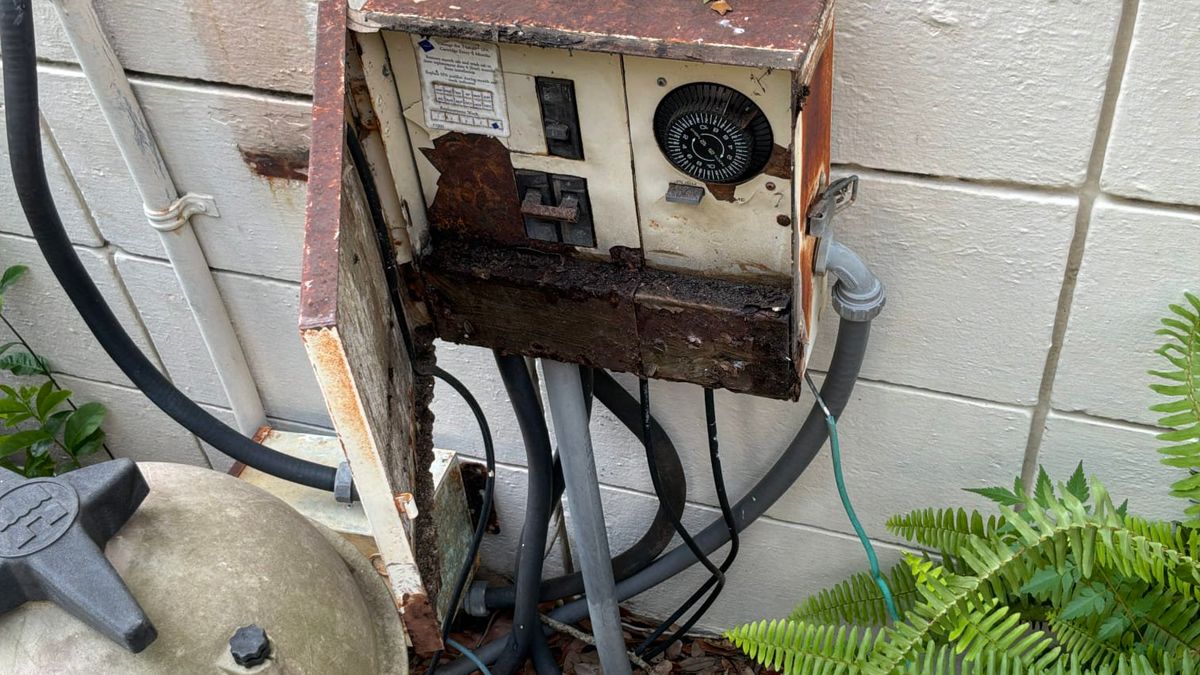
A homeowner in Palm Beach Gardens called about a kitchen breaker that tripped whenever the microwave and the toaster ran together. The breaker was not the problem. The panel behind it was close to thirty years old, mounted outdoors on a block wall a mile from the Intracoastal, and the bottom of the enclosure had rusted through. That story repeats from Tequesta down to Boca Raton and north through Stuart and Port St Lucie. Panels here rarely quit all at once. They warn you first, sometimes for years.
These are the seven warnings worth acting on.
- Rust streaks, chalky white powder, or water staining inside the enclosure.
- Breakers tripping on loads the circuit carried without complaint a few years ago.
- A cover that feels warm, or a hum or crackle you can hear standing in front of it.
- The smell of hot plastic, or a brown scorch mark at a breaker or a lug.
- Lights that dip hard every time the air handler or the pool pump starts.
- Every slot filled, with tandem breakers in positions never rated for them.
- A label reading Federal Pacific Stab-Lok, Zinsco, Challenger, or Pushmatic.
Salt Air Gets to the Enclosure Before It Gets to Anything Else
Most homes here keep the meter, the main disconnect, and often the panel itself outdoors on a concrete block wall. That is ordinary construction in Palm Beach and Martin counties, and it works until the coating on the can gives out. East of US 1 in Jupiter, North Palm Beach, Delray Beach, and Jensen Beach, salt-laden air finds every scratch and screw head. First comes orange staining along the bottom lip. Then chalky white oxide on the aluminum service conductors where they land on the main lugs.
That white powder matters more than the rust. Oxidized aluminum is a poor conductor, so the termination heats up, heat loosens the lug, and a looser lug runs hotter still. It is a loop that feeds itself. A torque check catches it early. A panel nobody has opened in twenty years is past that.
Hurricane season pushes the same problem indoors. An enclosure rated for wet locations is rated for rain falling down, not horizontal water at sixty miles an hour hunting for an open knockout or a failed hub. We open panels every summer with a tide line inside.
Florida Houses Ask More of a Panel Than They Used To
Air conditioning runs here nine or ten months a year. Add a variable speed pool pump, a salt chlorine generator, a well pump out in Palm City or Hobe Sound, and a car that charges overnight, and a service sized in 1978 is carrying a load nobody planned for. Plenty of homes in Lake Worth, Greenacres, and older Royal Palm Beach are still on a 100 amp service with no empty spaces left.
Seasonal homes have their own version. A house in Jupiter that sat closed all summer gets opened in November and everything comes on inside an hour. That is when a connection quietly corroding since spring announces itself.
Heat is the constant. Breakers and busbars are rated at a stated ambient temperature, and an unconditioned Florida garage in August is nowhere near it. The National Fire Protection Association tracks home electrical fires in its research reporting, and distribution and lighting equipment shows up year after year as a leading source. A warm cover or a burning smell is not a quirk to live with.
Some Panels Are a Problem Even When They Look Clean
Brand matters. Federal Pacific Stab-Lok, Zinsco and its Sylvania-branded versions, Challenger, and Pushmatic equipment all carry documented histories of breakers that fail to trip reliably or bus stabs that burn where the breaker clips on. A dry, dusted Stab-Lok panel is still a Stab-Lok panel.
The Four Point Inspection Angle
There is a practical consequence beyond safety. Carriers writing homeowners policies in Florida routinely require a four point inspection on older houses, and the electrical section names the panel manufacturer, the service size, and the branch wiring type. Those are underwriting rules the carriers set themselves, not anything the state imposes, and more than a few decline or non-renew over these brands. Owners in Boynton Beach and Port St Lucie often find that out at renewal.
What Replacing a Service Panel Actually Involves Here
A panel or service change is permitted work. Your building department, whether Jupiter, Palm Beach Gardens, the Palm Beach County Building Division, Martin County, or St Lucie County, issues the permit and inspects the finished job. FPL has to be scheduled to pull and reset the meter, so the house is usually dark for part of a day.
Replacing the service brings the installation up to current rules instead of the ones that applied when the house was built. The Florida Building Code, Eighth Edition, adopts NFPA 70, the National Electrical Code, and the change homeowners notice first is the emergency disconnect required at one and two family dwellings under NEC 230.85. That is the outdoor disconnect, marked as an emergency disconnect, that lets a firefighter kill power to the house from the yard without going inside. The 2020 code Florida enforces today requires that marking without specifying a color. The 2023 code calls for white lettering on a red background, and Florida picks that edition up with the Ninth Edition of the Florida Building Code on December 31, 2026. Working clearance at the panel, an accurate circuit directory, and current arc fault and ground fault protection come with it.
It is also the moment for two things people ask about later. A whole home surge device belongs at the panel, and the lightning density over Palm Beach and Martin counties makes that an easy call. If you keep a portable generator for storm season, a properly installed inlet with a mechanical interlock is the safe way to feed the house, and it has to land on gear that can accept it. FPL publishes how it sequences storm restoration, and getting the street back up does not help if the equipment on your wall cannot take power.
What To Do Next
If two or more of those signs describe what is on your wall, get eyes on it before the next storm tests it for you. Our team handles electrical panel upgrades across Jupiter, the Palm Beaches, and the Treasure Coast. If you are not sure where you stand, an electrical safety inspection documents the panel, the service, the grounding and bonding, and the branch circuits so you have something concrete to work from.
If the panel is hot, smells like burning plastic, sparks, or half the house goes dark for no reason you can find, do not wait for a scheduled visit. We answer and dispatch 24/7, so call our emergency line and shut the main off first if you can reach it safely.