Most homeowners meet their smoke alarms at two in the morning. One starts chirping, nobody can tell which one, and twenty minutes later three alarms sit on the kitchen counter with the batteries pulled. By sunrise the house has no working smoke detection at all. We see the aftermath all over Jupiter and Palm Beach Gardens, usually a week or two after a storm knocked out power and every alarm cycled onto backup.
Florida has a specific law about how those alarms are powered, and it changes what a replacement has to look like once permitted alteration work is involved.
What Florida Statute 553.883 Actually Says
Florida Statute 553.883 is titled “Smoke alarms in one-family and two-family dwellings and townhomes.” The part that affects most homeowners is short, and the trigger is the part people miss. A battery powered smoke alarm that is newly installed, or that replaces an existing battery powered alarm, as a result of a Level 1 alteration as defined in the Florida Building Code, has to run on a nonremovable, nonreplaceable battery rated to power the alarm for at least ten years. A unit you drop a fresh nine volt into every fall does not meet that standard. Outside of that trigger, swapping a tired battery alarm for a like unit is not itself a violation, but if you are buying alarms anyway, the sealed ten year battery is the one that still complies when alteration work does come along.
The statute also cuts in your favor. A one or two family dwelling or townhome going through a repair, or a Level 1 alteration as defined in the Florida Building Code, may use those sealed ten year alarms rather than retrofit the whole house with alarms powered by the building wiring. In a 1970s concrete block house in Lake Worth or Hobe Sound with a shallow truss attic, that saves a lot of drywall.
The section carves out exceptions, including alarms tied to a centrally monitored fire alarm system and certain wireless or multi-sensor devices listed by a nationally recognized testing laboratory. Read it yourself at Florida Statutes 553.883.
Carbon Monoxide Is a Separate Requirement
Smoke and carbon monoxide get lumped together in conversation, but Florida governs them separately. Statute 553.885, “Carbon monoxide alarm required,” applies to buildings and additions constructed on or after July 1, 2008 that have a fossil fuel burning heater or appliance, a fireplace, an attached garage, or another feature that emits carbon monoxide as a byproduct of combustion. Those need an approved, operational carbon monoxide alarm within ten feet of every room used for sleeping. A hardwired or battery unit satisfies it, and so does a combination smoke and CO alarm.
Plenty of homes on the Treasure Coast are all electric, so owners assume carbon monoxide is somebody else’s problem. An attached garage counts on its own, and so does a gas water heater, a propane range or a gas dryer. The largest exposure we see here is not a permanent appliance at all. It is the portable generator that comes out of the shed while FPL is still working through restoration, run too close to a window or, worse, inside a screened lanai. A screen enclosure does not move air the way people assume. Test the CO alarms before hurricane season instead of after the storm.
Where the Alarms Actually Go
Placement comes out of the Florida Building Code, Residential, Section R314 for smoke alarms and Section R315 for carbon monoxide alarms. For a typical Palm Beach County or Martin County floor plan that works out to:
- Inside every bedroom
- Outside each sleeping area, in the hallway that serves those bedrooms
- On every level of the house, including a bonus room over the garage
- Carbon monoxide alarms within ten feet of each sleeping room, where the requirement applies
The placement mistakes that cause nuisance alarms
Do not mount a smoke alarm right outside a bathroom door where shower steam rolls into the hall. Do not put one in the path of a supply register or a ceiling fan, because moving air keeps smoke off the sensor. Do not tuck one into the peak of a vaulted ceiling where the air is dead, and keep them back from the range in an open kitchen. Photoelectric sensing handles cooking smoke and humidity better than ionization does, which matters in an open plan Wellington or Royal Palm Beach house where the range and the hallway alarm are twelve feet apart.
Why Alarms Age Out Faster on the Coast
The NFPA recommends replacing smoke alarms ten years from the date of manufacture, not ten years from the day somebody installed them. Twist one off the ceiling and the date is stamped on the back. Carbon monoxide alarms usually age out sooner, often around seven to ten years. The NFPA home smoke alarm guidance spells out the replacement interval and the monthly test routine.
Coastal Florida is hard on these devices. Sensing chambers breathe humid air all day, and along the water in North Palm Beach, Tequesta and Jensen Beach the salt in that air corrodes contacts and the interconnect terminals behind the plate. Fine drywall dust from a remodel settles into the chamber and never leaves. Neither do the small insects that work in through the vents, which is a common reason an alarm sounds at random with no smoke anywhere.
Then there is lightning. Florida takes more strikes than any other state, and a nearby hit or a surge riding in behind an FPL restoration can kill the electronics in a hardwired alarm with no outward sign of damage. If your alarms used to sound together and now only the hallway unit goes off, a dead alarm or a damaged interconnect conductor is usually the reason.
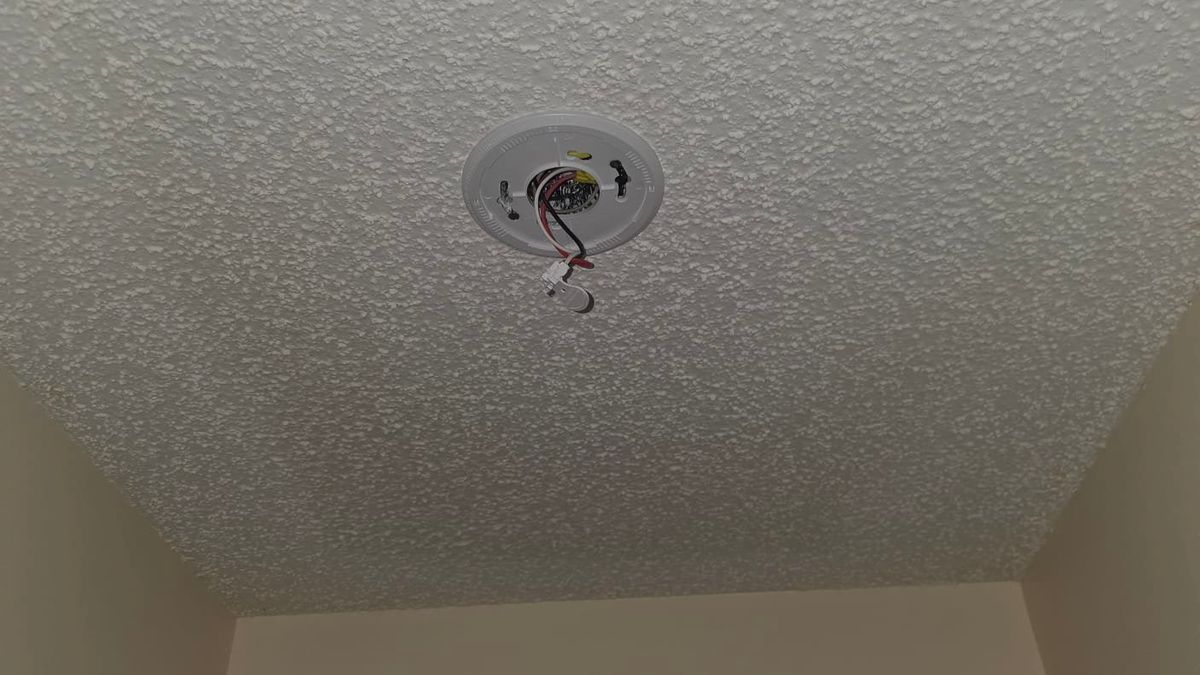
In older houses the alarm circuit is frequently spliced onto a lighting circuit inside a box nobody has opened in forty years. If we pull a plate and find scorched insulation, a brittle jacket or terminations that have been running warm, the alarm is the smaller problem. That is a conversation about rewiring the affected branch circuits, not a device swap.
What to Do This Weekend
Take a step stool through the house. Pull each alarm down, read the date on the back, press the test button, and put it back. Anything past ten years comes down for good. If you find bedrooms with no coverage, alarms that are not interconnected, or a hardwired set that quit talking to each other after the last storm, an electrical safety inspection sorts it out efficiently, because the same visit covers the panel, the GFCI protection and the bonding instead of only the ceiling.
If an alarm sounds with no explanation, if you smell something hot, or if a carbon monoxide alarm goes off, get everyone outside and call from the driveway. We answer and dispatch around the clock, so emergency service in Jupiter, Stuart and Port St Lucie is a phone call, not a wait until Monday.