A squall line pushes through Jupiter at four in the afternoon. By dark the FPL crews have the feeder back up, the streetlights are on, and the neighbor’s pool pump is humming again. Your house is still black. The utility checks the line and tells you power is good to the meter, so the problem is on your side.
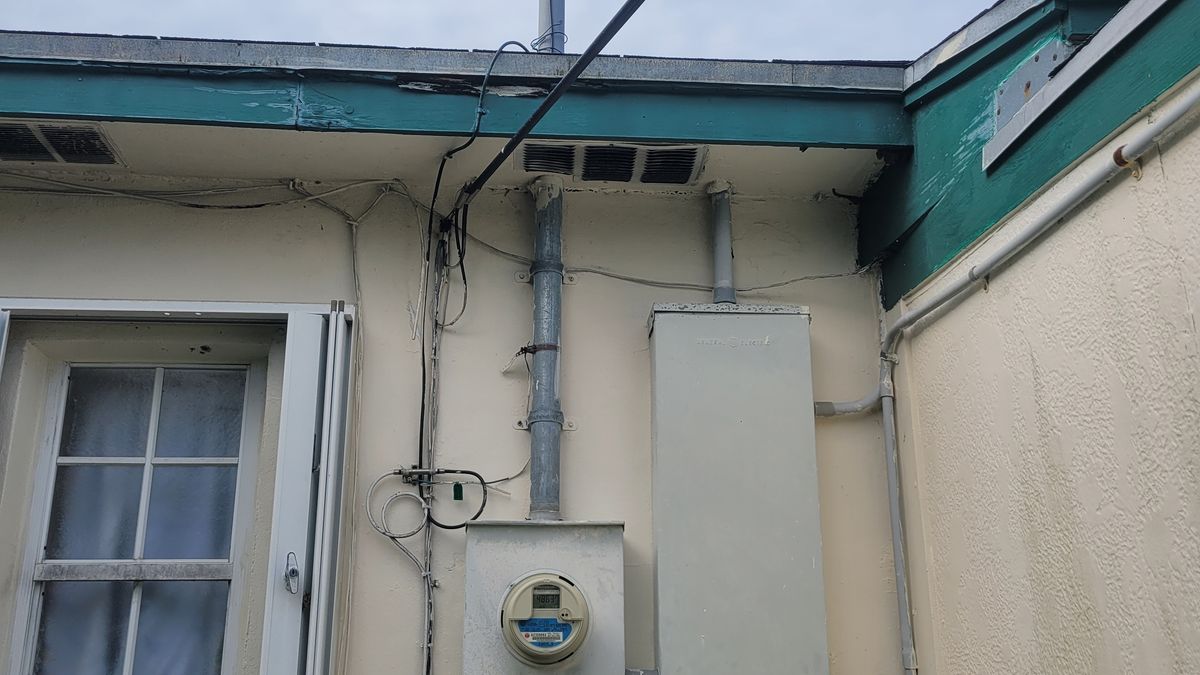
Your side is usually a length of pipe running up the outside wall past the roofline, with a fitting on top where the utility wire lands. The pipe is the service mast, or riser. The fitting is the weatherhead. When either one fails, the whole street can come back on while your house sits dark.
Where FPL Stops and Your Equipment Starts
FPL owns the overhead service drop, the conductors strung from the pole to the house, and it owns the meter. Almost everything those conductors land on belongs to the property owner: the weatherhead, the mast, the straps that hold it, the meter enclosure, and the panel behind the wall. FPL spells the split out on its storm and restoration pages.
So a lineman can re-energize the transformer feeding your street and drive off while you sit dark. He is not being difficult. He cannot reconnect to a weatherhead that has torn off a wall, and across Palm Beach, Martin and St Lucie counties he will not reconnect until a licensed electrical contractor makes the repair and the building department passes the inspection. In Tequesta, Hobe Sound and North Palm Beach this plays out after nearly every serious storm.
What Actually Fails Up There
Salt air eats the mast
Within a couple of miles of the Atlantic, galvanized rigid conduit loses its zinc coating far faster than inland. Threads at the couplings go first, then the strap points, then the pipe wall. On coastal homes in Jupiter and Jensen Beach a mast can look sound from the driveway and still be paper thin behind a strap.
Water follows the wire down
A weatherhead is supposed to shed rain. When the gasket hardens, or the drip loops below it were never formed with enough sag, water runs along the conductors into the fitting and down the mast. Months later somebody pulls a meter can cover in Palm Beach Gardens and finds green corrosion on the lugs, a weatherhead problem showing up two feet lower.
The drop is a lever
Every gust on the service drop pulls the top of the mast, which pivots against the roof penetration. Put a ficus limb into that drop during a tropical system and the load spikes. Concrete block homes around West Palm Beach, Lake Worth and Greenacres often still carry an original mast, braced for a far smaller service than the house now draws.
Warning signs visible from the ground:
- The mast leans toward the pole, or the roof flashing around it has opened up.
- Rust streaks running down the stucco below the weatherhead or the meter can.
- The drop hangs noticeably lower than it does on neighboring houses.
- A scorch mark, a buzzing sound, or a burnt smell at the meter enclosure.
- Lights that dim and surge together on half the house, a possible failing service neutral.
The Code Rules That Decide Whether It Passes
All of this lives in Article 230 of NFPA 70, the National Electrical Code, which Florida enforces through the electrical provisions of the Florida Building Code.
Section 230.54 covers the service head: raintight, mounted above the point where the utility conductors attach, with drip loops below it so water sheds off instead of tracking inside. Section 230.24 covers clearance, ten feet above finished grade at the lowest point of the drip loop where only people walk, twelve feet over a residential driveway, eight feet above a roof surface, with narrow exceptions. A new paver driveway under an existing drop can put a forty year old service out of compliance without anyone touching a conductor.
Section 230.28 says the mast has to be strong enough on its own or properly braced, and that nothing except the utility’s service conductors may hang on it. Cable and telephone lines lashed to a mast are both a violation and a common reason masts bend. Section 230.85 requires an emergency disconnect at one and two family dwellings, so replacing service equipment now means an accessible outdoor disconnect marked for emergency use, giving fire crews a way to kill the house from outside.
How the Repair Actually Runs
The permit comes first, pulled with the county or city where the house sits. Stuart, Palm City and Port St Lucie each run their own inspection schedules, and so do Boca Raton, Delray Beach and Boynton Beach. Then FPL is scheduled to release the drop.
The mast, weatherhead, service entrance conductors and meter enclosure usually get replaced as one assembly. Saving a corroded meter can under a brand new mast is how a homeowner does the job twice. The building department inspects, and only after it passes will FPL reconnect and reset the meter. After a named storm both queues run long across the Treasure Coast, the honest reason same day restoration is not always possible.
Since the service is already dead and the meter already pulled, this is the moment to deal with a tired panel behind that wall. If yours is undersized, obsolete, or rusting from the same water that came down the mast, folding an electrical panel upgrade into the same permit and outage saves a second disconnect later. It is also when a portable generator inlet and a panel interlock make the most sense, so the next long restoration is something you ride out safely instead of running cords through a lanai door.
If Your House Is the Only Dark One Tonight
Do not put a ladder against a leaning mast, do not pull on a low hanging drop, and stay clear of a downed conductor even if the streetlights are back on. Assume it is live. Get everyone away from the meter wall, then call it in. We answer and dispatch around the clock for electrical emergencies, and a mast separating from a house is exactly that.
If you are reading this on a calm day and just noticed a rust streak under the weatherhead on your Wellington or Royal Palm Beach home, that is the better version of this story. An electrical safety inspection covers the mast, weatherhead, meter enclosure, grounding and bonding, and the panel, and leaves a written record that helps when a 4-point inspection comes due on an older Palm Beach County house.