
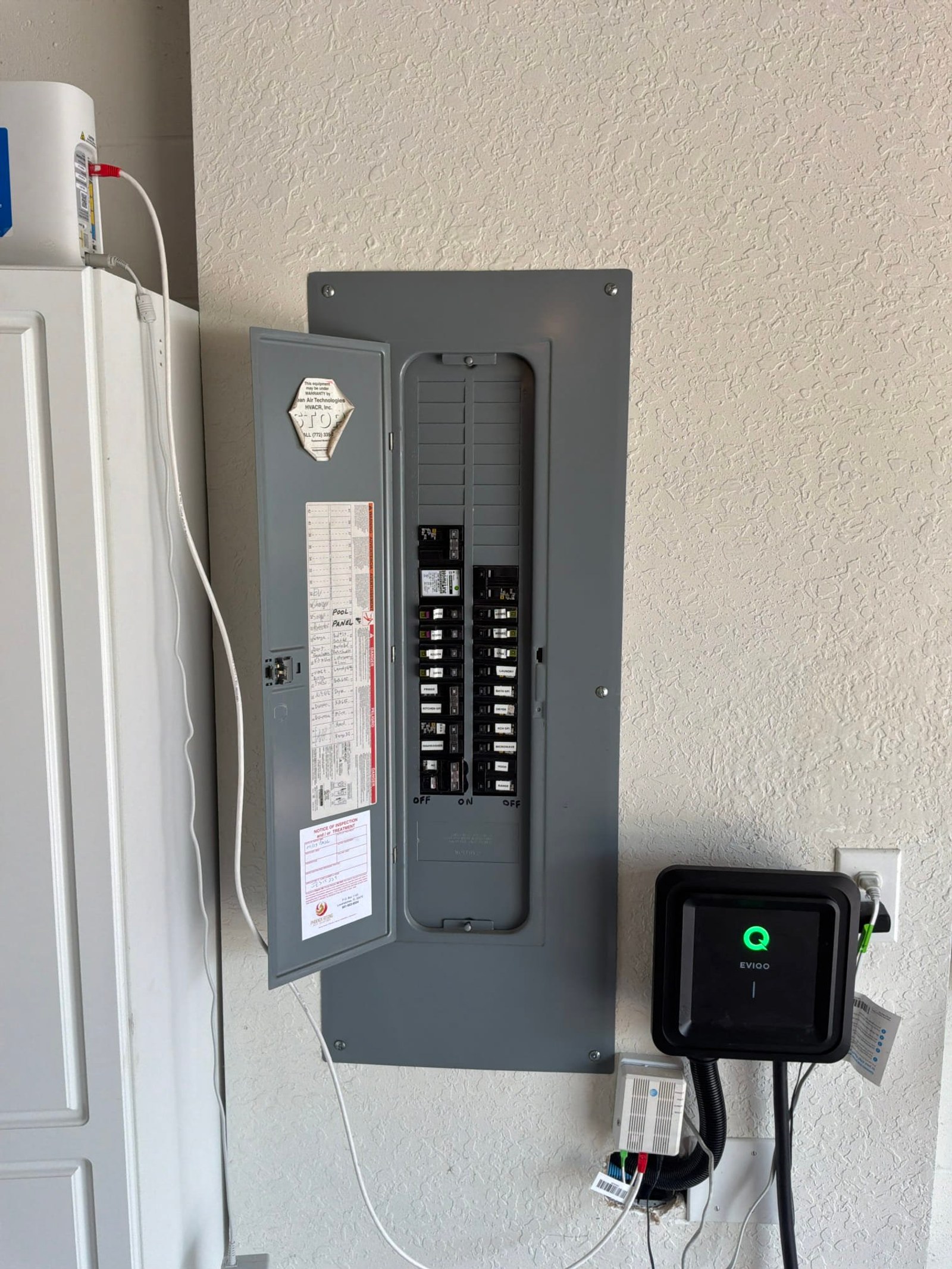
This Port St. Lucie EV charger installation case study walks through the real diagnosis, the fix, and the code details from a recent service call. A homeowner in Port St. Lucie, FL wanted the convenience of charging their electric vehicle overnight at home, without relying on a slow Level 1 outlet. Our field team installed a customer-supplied Eviqo Level 2 EV charger on the exterior wall, drawing a dedicated circuit from the existing Siemens 200-amp panel.
Customer’s Problem
The homeowner had recently acquired an electric vehicle and wanted a faster, more practical charging solution at home. A standard wall outlet simply could not keep pace with daily driving needs. They had already selected their charger and needed a licensed team to handle the circuit work and mounting.
What Our Electrician Found
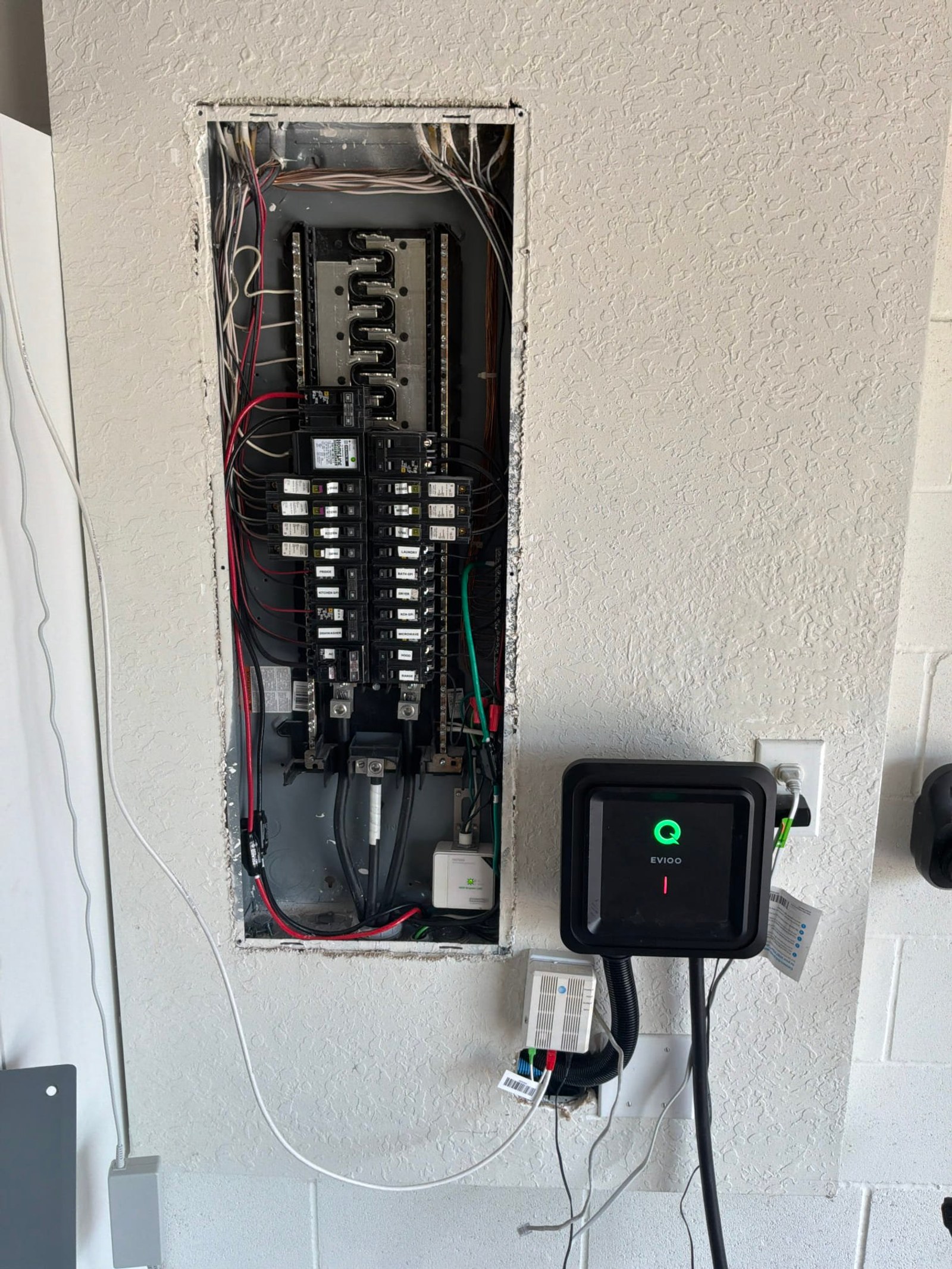
Before the installation began, the licensed electrician on site reviewed the Siemens 200-amp breaker panel to confirm it could support the new dedicated circuit. The panel interior, visible in the job photos, shows black, red, and green conductors routed neatly alongside the existing breaker arrangement and neutral bar.
During the walkthrough, the team also noted several conditions in the broader electrical system that are worth flagging for the homeowner’s awareness. These are observations about the home’s overall electrical setup, not problems created by the EV charger work itself.
Panel and Service Observations
The inspection checklist identified several items that did not meet current standards. These included the absence of whole-home surge protection and AFCI protection on applicable branch circuits, along with questions about main breaker sizing, meter can condition, and whether wires are properly sized for all connected equipment. None of these conditions are uncommon in homes of this era, and many were permissible under the code cycle when the home was originally wired. However, today’s NEC 2020 recommends addressing them as part of a phased modernization plan.
Receptacle and Wiring Observations
The checklist also flagged backstabbed outlets as a concern. Backstabbing was a common wiring shortcut in residential construction before roughly 2005. Over time, the spring tension in backstabbed connections can ease, which leads to increased contact resistance and the kind of intermittent flicker or warm outlet that homeowners occasionally notice. Transitioning to screw-terminal connections is a straightforward upgrade whenever those outlets are next replaced.
Additionally, the inspection noted the absence of tamper-resistant receptacles throughout the home. Current code, under NEC 406.12, requires tamper-resistant outlets in new and replacement installations in dwelling units. For families with young children, this is one of the more meaningful comfort upgrades available.
Solution Selected
The homeowner chose to move forward with the EV charger installation using the unit they had already purchased. The scope covered supplying labor and materials to mount and wire the customer-provided Eviqo charger. Circuit work, breaker, permit, and any disconnect hardware were not included in this scope and would be addressed separately if needed.
Work Performed
Our crew mounted the customer-supplied Eviqo Level 2 EV charger on the exterior wall adjacent to the main electrical panel. The unit is a weatherproof installation, suited for outdoor use in Florida’s climate. The team routed conductors from the Siemens 200-amp panel to the charger location, completing the connection within the existing service capacity.
The result is a dedicated Level 2 charging station that can fully recharge most electric vehicles overnight, ready every morning without any extra effort from the household.
Why Pricing Can Vary
Two homes with the same job on the invoice can land at different totals. On projects like this one, the total is driven by:
- Charger amperage and whether it is hardwired or plugged into a receptacle
- Distance and route from the panel to the parking location
- Available capacity in the existing panel and whether a load calculation allows the new circuit
- Load management or a panel upgrade when capacity is not available
- Wall material, attic or crawlspace access and any conduit runs outdoors
- Charger brand, model and any smart features
- Permit and inspection requirements
- GFCI and disconnect requirements for the location
Why This Port St. Lucie Ev Charger Installation Matters for Homeowners
For a family in Port St. Lucie, FL, having a Level 2 charger at home changes the daily routine in a straightforward way. Instead of stopping at a public charging station or waiting through a slow trickle charge, the car is simply ready when the day starts. Plug in when you get home, and it takes care of itself while the household winds down for the evening.
Additionally, a dedicated circuit protects the home’s broader electrical system from the sustained load that EV charging places on a circuit. Under NEC 625.42, EV charging equipment must be treated as a continuous load, meaning the circuit is sized at 125 percent of the charger’s rated current. This gives the panel the headroom it needs to handle charging alongside the rest of the home’s everyday demands, so the family never has to think about it.
Finally, the inspection observations noted above represent an opportunity to keep this home’s electrical system moving in a modern direction. Adding surge protection, for example, means the EV charger, along with every other appliance and device in the home, rides out Florida’s frequent lightning storms without skipping a beat. Our licensed team is happy to walk through any of those next steps whenever the homeowner is ready.
“Jared was great! Very courteous and kind and new exactly what he needed to do with this installation. I would definitely ask for him again”
Code Compliance Cited in This Job
Every fix above maps to a specific section of NEC 2020. Each card links to NFPA’s public NEC index.
EV Charging Branch-Circuit Ampacity
NEC 625.41 requires the branch circuit supplying EV charging equipment to be sized for the continuous load the charger will draw. On this job, the dedicated circuit feeding the Eviqo Level 2 charger was laid out to meet this requirement, drawing from the existing Siemens 200-amp service. NFPA reference ›
EV Charging Continuous-Load Rating
NEC 625.42 classifies EV charging as a continuous load, requiring the circuit to be rated at 125 percent of the charger’s nameplate current. This ensures the Siemens 200-amp panel has adequate headroom to support the charger alongside the home’s other circuits without nuisance tripping. NFPA reference ›
AFCI Protection
NEC 210.12 requires arc-fault circuit-interrupter protection on most branch circuits in dwelling units, including bedrooms, kitchens, and living areas. The inspection flagged AFCI protection as absent on applicable circuits in this Port St. Lucie home, representing an opportunity to bring those circuits in line with current standards. NFPA reference ›
Surge Protective Device at Service
NEC 230.67 requires a surge protective device at the service entrance of a dwelling unit. The inspection noted that whole-home surge protection was not present, which means the EV charger and other sensitive electronics currently lack that added layer of reliability during Florida’s frequent lightning storms. NFPA reference ›
Tamper-Resistant Receptacles
NEC 406.12 requires tamper-resistant receptacles in all new and replacement outlet installations in dwelling units. The inspection identified standard receptacles throughout the home, which predate this requirement. Replacing them over time with tamper-resistant outlets brings the home in line with current code. NFPA reference ›
Common Questions
Questions homeowners ask after seeing this kind of work.
What is the difference between a Level 1 and a Level 2 EV charger for a home in Port St. Lucie, FL?
A Level 1 charger uses a standard 120-volt outlet and typically adds only 3 to 5 miles of range per hour, which can mean days to fully recharge some vehicles. A Level 2 charger, like the Eviqo unit installed on this job, operates on a 240-volt dedicated circuit and can add 20 to 30 miles of range per hour, so most vehicles are fully charged by morning. For households that drive daily, Level 2 is the practical choice. Schedule online to find out whether your panel has room for a dedicated Level 2 circuit.
Can my existing Siemens 200-amp panel handle the load of a Level 2 EV charger?
A Siemens 200-amp panel generally has the capacity to support a Level 2 EV charger, though a licensed electrician needs to review the existing load and available breaker slots before committing to a circuit. On this job, the field team confirmed the panel could accommodate the new circuit. If your home has a similar setup, a quick assessment will give you a clear answer. Schedule online for a load evaluation.
Does a Level 2 EV charger installation require a permit in Port St. Lucie, FL?
Yes, a dedicated 240-volt circuit for an EV charger typically requires an electrical permit from the local jurisdiction. Permitting ensures the work is inspected and meets current NEC standards, including the continuous-load sizing requirements under NEC 625.42. The scope on this particular job did not include a permit, so the homeowner should confirm permit status with the local building department. Our team is happy to discuss permit requirements for your project. Schedule online to talk through the details.
How often should I have my home’s electrical system inspected, especially after adding an EV charger?
A yearly electrical inspection is a good baseline for most homes. Homes built before 1990, or those that have come through recent storms, may benefit from inspections more often, particularly because older wiring and equipment may predate current NEC standards. Adding a high-draw device like an EV charger is also a good trigger to have the full system reviewed. Schedule online to book your annual inspection.
The inspection found that surge protection is not present. Does that affect my new EV charger?
Without whole-home surge protection at the service entrance, the EV charger and all other connected electronics are exposed to voltage spikes from Florida’s frequent lightning activity. NEC 230.67 now requires a surge protective device at the service for dwelling units. Adding one means your EV charger, appliances, and home electronics all stay protected through every storm and season, without any extra effort on your part. Schedule online to add surge protection to your next service visit.
Project Photos
Electrician and Technical Reviewer
Work performed by Jared, Thomas Edison Electric field electrician serving Jupiter / West Palm Beach.
Jared, the electrician on this job, is the technical reviewer of record for this case study.
Location
This project was completed in Port St. Lucie, Florida, in our Greenacres / Royal Palm Beach service area.