
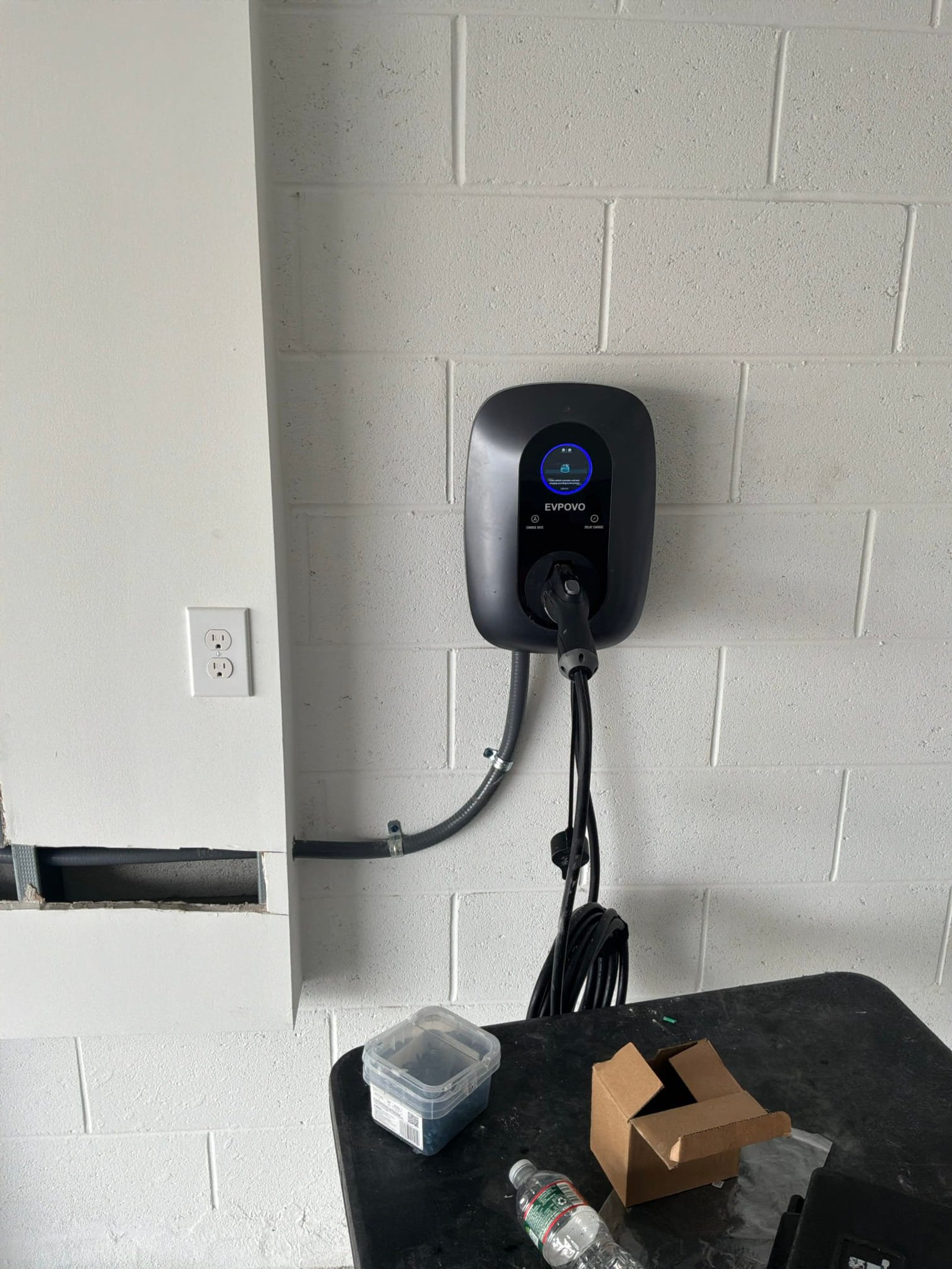
This Port St. Lucie EV charger installation case study walks through the real diagnosis, the fix, and the code details from a recent service call. A homeowner in Port St. Lucie, FL wanted to stop relying on a standard wall outlet to charge their electric vehicle. Our field team installed a dedicated 240-volt circuit from the existing garage panel, hardwired a wall-mounted EVPOVO Level 2 EV charger, and left the panel directory clearly labeled so everything is easy to identify going forward.
Customer’s Problem
The homeowner had already chosen their EV charger and wanted it professionally installed before their new vehicle arrived. A Level 2 charger needs its own dedicated 240-volt circuit, so a standard household outlet simply would not do. The goal was a clean, code-consistent installation that would be ready to use on day one.
What Our Electrician Found
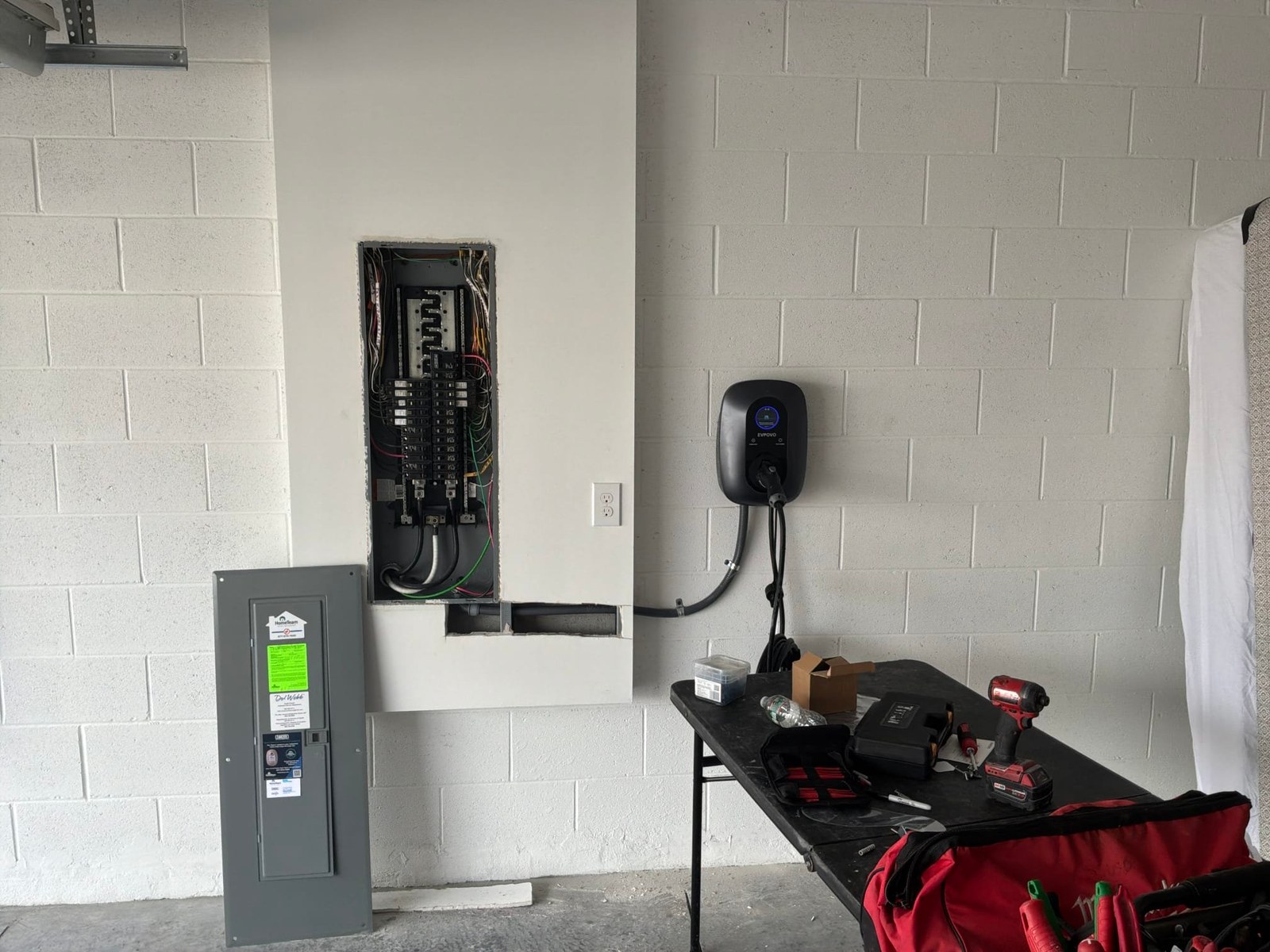
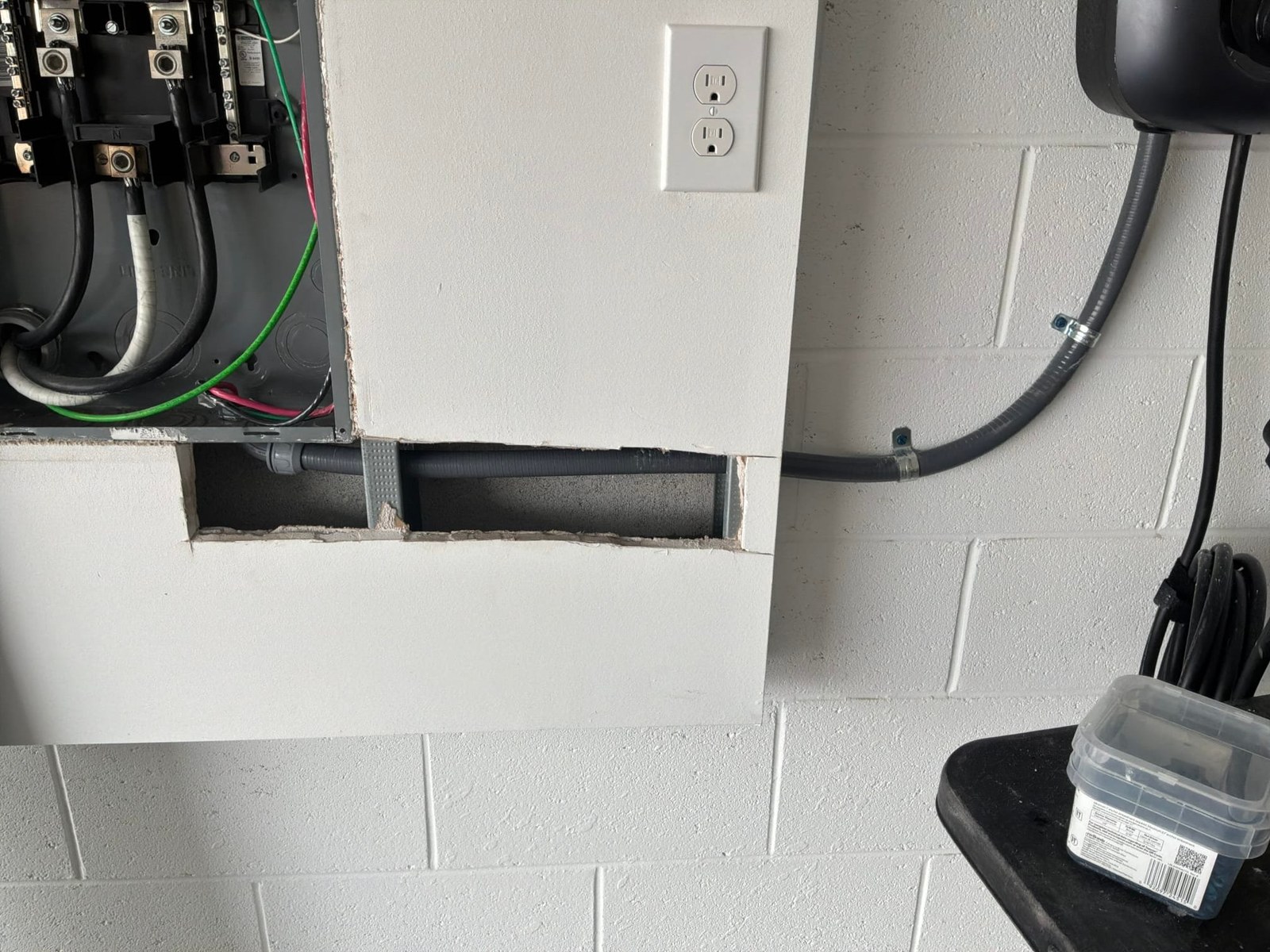
The existing garage panel had room for a new two-pole breaker, which was the right starting point. Our technician checked the existing panel for space and capacity for a new two-pole breaker before any work began. The charger location on the garage wall was mapped out, and the route for the new circuit was planned to keep the conduit run clean and direct. Photo documentation from the job shows black conduit running along the wall to a device box, the charger mounted on a white brick wall, and the EVPOVO unit’s blue display panel ready for use.
Solution Selected
Because the scope was pre-planned and the charger was customer-supplied, the team moved straight into installation. The homeowner chose a full hardwired setup rather than a plug-in approach, which is the more permanent and reliable option for daily home charging.
Work Performed
- Dedicated 240-volt circuit: The crew ran 6 AWG (6/3 Romex) wiring through the garage to the charger location, providing the capacity a Level 2 charger requires.
- Square D Homeline two-pole breaker: A new 60-amp two-pole breaker was added to the existing panel to serve the charger circuit, sized to the charger the homeowner had chosen.
- EVPOVO wall-mounted EV charger: The customer-supplied EVPOVO unit was hardwired and mounted on the garage wall. Its blue display was confirmed active after the circuit was energized.
- Panel directory label: The new breaker was labeled in the panel directory so the circuit is easy to identify now and in the future.
- Light fixture: A lay-in light fixture was also installed at an existing powered location in the garage, improving visibility in the workspace.
- Drywall patch: Any wall openings from the circuit run were patched before the team left.
Important Materials and Equipment
Materials and equipment on the invoice for this project:
- Romex Wire 6/3 NM Price Per Foot (quantity 15)
- HOM260 Square D HomeLine Breaker Two Pole 60 Amp
Why Pricing Can Vary
Two homes with the same job on the invoice can land at different totals. On projects like this one, the total is driven by:
- The scope agreed after the on-site assessment
- Access, materials and the condition of the existing system
- Permit and inspection requirements
Why This Matters for Homeowners
For a household with an electric vehicle, the difference between a Level 1 trickle charge and a Level 2 dedicated circuit is significant. A standard 120-volt outlet trickles charge back in slowly, which is fine for a short commute and frustrating for anything more. A dedicated 240-volt circuit charges far faster, so the car is ready when the household needs it.
Additionally, a hardwired installation is more durable than a plug-in setup for everyday use. There are no adapters to manage, no cords draped across the floor, and no worry about whether the connection is seated correctly. The EVPOVO unit sits flush on the wall with its cable coiled and ready, as shown in the completed installation photo.
Finally, having a dedicated, properly rated circuit protects the home’s electrical system over the long run. Under NEC 625.41, EV charging load is treated as a continuous load, so the circuit is sized against the charger’s rated current rather than its average draw. That sizing, decided on site against the unit the homeowner bought, is what lets a circuit take a daily charging cycle year after year without running hot.
Code Compliance Cited in This Job
Every fix above maps to a specific section of NEC 2020. Each card links to NFPA’s public NEC index.
EV Charging Branch-Circuit Ampacity
NEC 625.41 treats electric vehicle charging load as continuous, so the branch circuit and its overcurrent protection are sized against the charger’s rated current rather than its average draw. On this job that meant a dedicated circuit for the charger alone, with a new 60-amp two-pole breaker and 6 AWG conductors, rather than sharing an existing garage circuit. NFPA reference ›
EV Charging Continuous-Load Rating
NEC 625.42 covers the rating of the charging equipment itself and how that rating sets the circuit it needs. The unit here was hardwired to its own 240-volt circuit rather than run through an adapter on a shared one, which is the arrangement the section is written around. NFPA reference ›
Circuit Directory Labeling
NEC 408.4 requires that every circuit in a panelboard be legibly identified. After adding the new two-pole breaker for the EV charging circuit, the field team labeled the panel directory so the new circuit is clearly identified for any future service or inspection. NFPA reference ›
Common Questions
Questions homeowners ask after seeing this kind of work.
Why does a Level 2 EV charger need its own dedicated circuit?
A Level 2 charger draws power continuously for several hours at a time, which is exactly the kind of load that demands a dedicated circuit. Sharing a circuit with other garage devices introduces the risk of nuisance trips and puts unnecessary thermal stress on shared wiring. A dedicated 240-volt circuit sized to NEC 625.41’s continuous-load rule keeps everything running smoothly every night. If your garage isn’t wired for one yet, our team can schedule a same-day assessment to see what your panel can support.
What size breaker is needed for a home EV charger?
The correct breaker size depends on the charger’s rated output current. Because EV charging is a continuous load, NEC 625.41 requires the circuit to be rated at 125 percent of the charger’s maximum current draw. On this Port St. Lucie installation, a 60-amp two-pole Square D Homeline breaker was the right fit for the EVPOVO unit. Always verify the charger’s spec sheet before sizing the breaker. Book a consultation and our licensed team can walk through the calculation with you.
Can I install a customer-supplied EV charger, or does it need to be purchased through the electrician?
In most cases, yes, a licensed electrician can hardwire a customer-supplied charger as long as the unit is a listed product appropriate for residential use. On this job, the homeowner provided the EVPOVO charger and our crew handled the circuit, breaker, conduit run, and installation. The key is making sure the charger’s specs match the circuit that is being built for it. Reach out to schedule and we can confirm compatibility before the appointment.
How long does it take to install a dedicated EV charging circuit in a garage?
Most single-car garage EV charger installations with an accessible panel take roughly two to four hours, depending on the distance from the panel to the charger location and whether any drywall work is involved. On this job, the team also patched the wall after routing the circuit, keeping the garage looking clean. Timelines can vary, so the best way to get an accurate estimate is to book a visit so we can see the panel and layout in person.
How often should I have my home’s electrical system inspected?
A yearly inspection is a good baseline for most households, especially after adding a significant new load like an EV charger. Homes built before 1990 and homes that have been through recent storms may benefit from checkups more often, since aging wiring and weather events can each affect how a system performs over time. Staying on an annual schedule means small items get caught early, and the household keeps running the way you expect it to. Schedule your yearly inspection online and we will take care of the rest.
Project Photos
Electrician and Technical Reviewer
Work performed by Jared, Thomas Edison Electric field electrician serving Jupiter / West Palm Beach.
Jared, the electrician on this job, is the technical reviewer of record for this case study.
Location
This project was completed in Port St. Lucie, Florida, in our Saint Lucie County service area.