
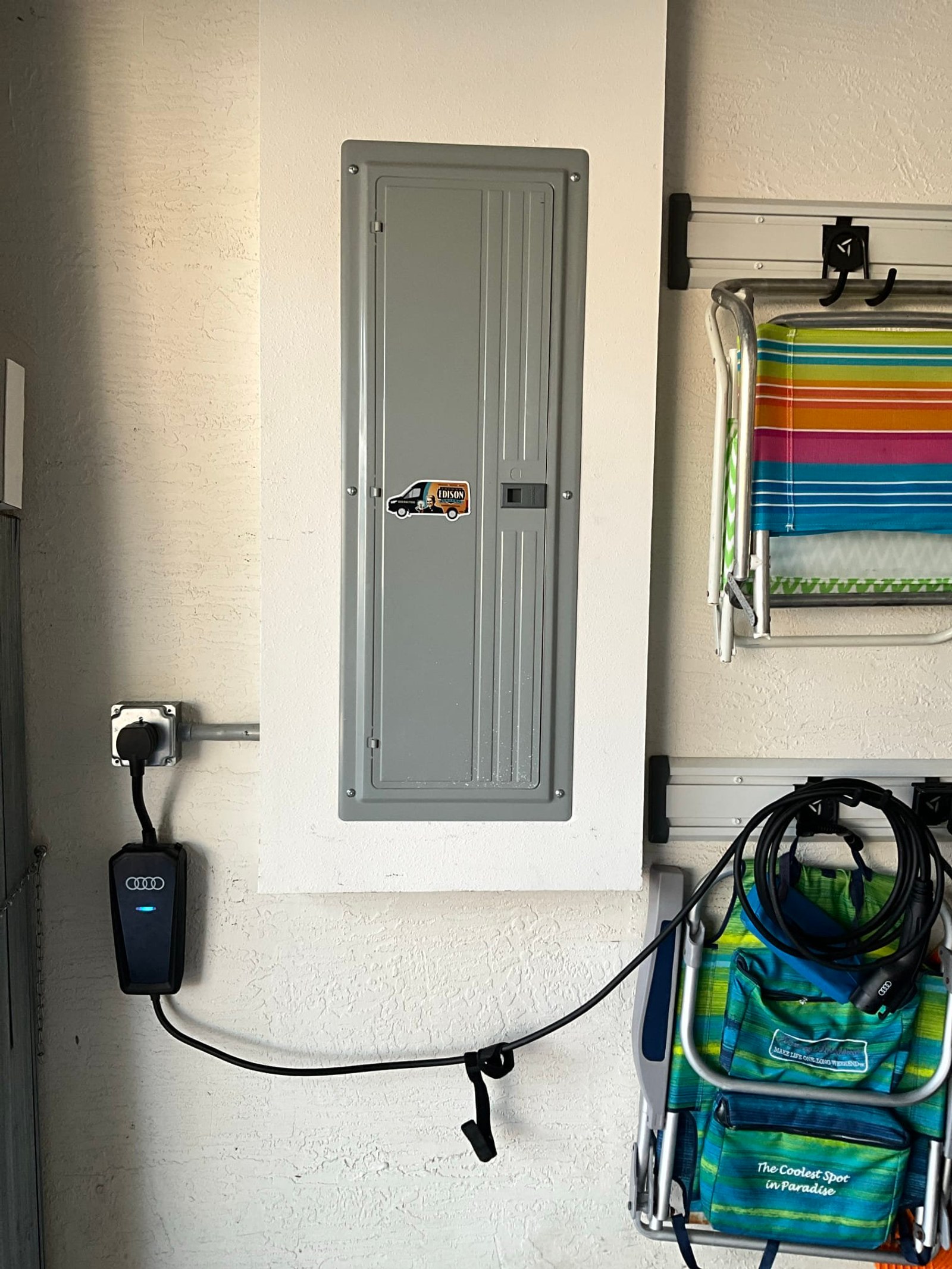
This Wellington outlet repair case study walks through the real diagnosis, the fix, and the code details from a recent service call. A homeowner in Wellington, FL wanted reliable at-home EV charging in their garage. Our field team installed a dedicated NEMA 14-50 outlet on a new 50-amp circuit, complete with a two-gang recessed box and a code-compliant GFCI breaker. While on-site, the team also walked through the home’s electrical system and noted several areas worth addressing in future visits.
Customer’s Problem
The homeowner was ready to charge their EV at home instead of relying on public stations. They needed a proper 240-volt outlet in the garage, one that could handle the continuous load of overnight charging without leaning on an existing circuit. Our office scheduled the installation, and the field team arrived ready to run a clean, dedicated circuit from the panel to the garage wall.
What Our Electrician Found
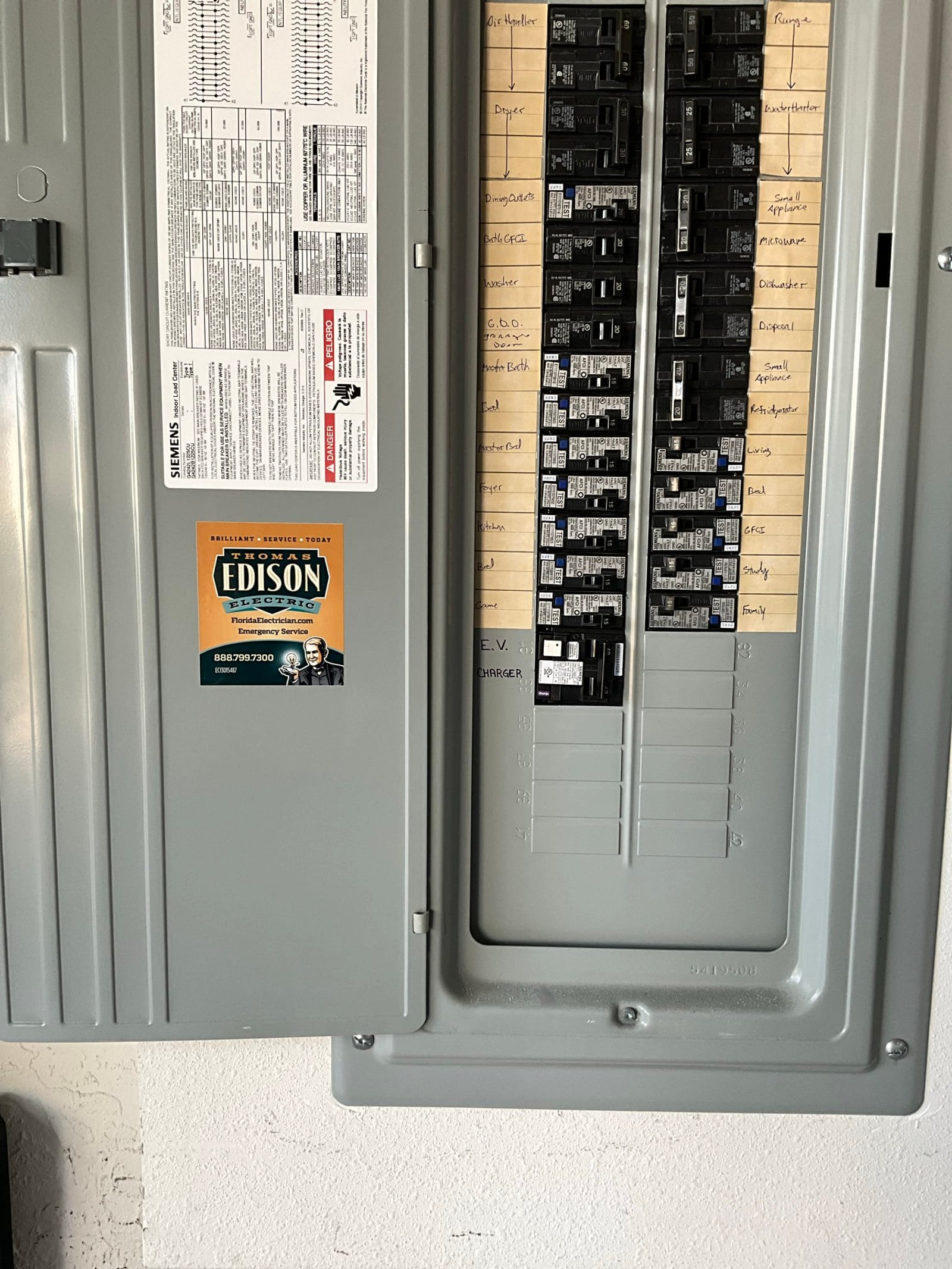
Before pulling wire, the licensed electrician on-site opened the GE 200-amp panel to plan the new circuit. Inside, the circuit directory showed handwritten labels on cardboard strips, a common sight in homes of this era and something that works fine day-to-day but can slow down future troubleshooting. Current standards under NEC 408.4 call for a clear, durable circuit directory, so this is worth updating on a future visit.
The panel review also flagged the absence of whole-home surge protection and AFCI protection on certain branch circuits. Neither condition is unusual for a home of this vintage. However, both represent straightforward upgrades that add a meaningful layer of reliability for modern electronics and appliances. Additionally, the team noted a handful of concerns across the home: outlets that may benefit from grounding verification, GFCI coverage in required areas worth confirming, smoke detectors and carbon monoxide detectors that may not reflect current NFPA 72 placement guidelines, and a weatherhead and meter can worth a closer look on a follow-up visit.
None of these observations change the story of the day. The panel had capacity for the new circuit, and the installation moved forward smoothly.
Solution Selected
The homeowner chose to move forward with the full dedicated EV outlet installation. Given that the vehicle charges overnight on a 240-volt circuit, a properly sized, GFCI-protected 50-amp dedicated run was the right fit for both the load and the long-term reliability of the system.
Work Performed
Our crew installed a new 50-amp, four-wire circuit from the GE 200-amp panel to the garage wall. The circuit feeds through an Eaton GFTCB240 40-amp two-pole GFCI breaker at the panel, providing built-in ground-fault protection for the entire run. At the wall, the team mounted a P242RRD recessed two-gang range/dryer box with a Heavy Duty 50-amp 125/250V NEMA 14-50R four-wire receptacle and finished it with a Leviton SL703 stainless steel two-gang wall plate. The result is a wall-mounted outlet in the garage, ready for the Audi’s charging cable, with a clean, protected termination at every point in the circuit.
Why Pricing Can Vary
Two homes with the same job on the invoice can land at different totals. On projects like this one, the total is driven by:
- Charger amperage and whether it is hardwired or plugged into a receptacle
- Distance and route from the panel to the parking location
- Available capacity in the existing panel and whether a load calculation allows the new circuit
- Load management or a panel upgrade when capacity is not available
- Wall material, attic or crawlspace access and any conduit runs outdoors
- Charger brand, model and any smart features
- Permit and inspection requirements
- GFCI and disconnect requirements for the location
Why This Wellington Outlet Repair Matters for Homeowners
At-home EV charging changes the morning routine in a quiet but meaningful way. Instead of planning trips around public charger availability, the family plugs in at night and wakes up to a full battery. That kind of reliability, repeatable every single day, is exactly what a dedicated circuit is designed to deliver.
The Eaton GFTCB240 GFCI breaker adds a layer of protection at the source. Ground-fault current on a 240-volt circuit is the kind of thing most homeowners never think about, and that is the point: with GFCI protection built into the breaker, the household does not have to think about it. The circuit does its job quietly, every charge cycle.
The panel findings noted during the visit are worth keeping in mind for future planning. Upgrading the circuit directory to a printed, durable label set makes every future service call faster. Adding whole-home surge protection means the family’s electronics, including the EV charger itself, ride through Florida’s lightning season without skipping a beat. Our team is happy to walk through those options at a follow-up visit whenever the timing feels right. In the meantime, the garage is ready, the outlet is in, and the car charges every night exactly as the household expects.
“We had a great experience with Thomas Edison from start to finish. Cristina was the professional assigned to our project, and she was outstanding throughout the entire process. From the very first conversation to the final installation, she was knowledgeable, responsive, and highly professional. We had an EV charger installed at our home, and the quality of the work and the guidance we received exceeded our expectations. Cristina took the time to explain our options, answered all of our questions, and made sure everything was completed smoothly and to a very high standard. If you’re looking for a reliable and professional company for an EV charger installation, I would highly recommend Thomas Edison, and especially Cristina. Thank you for an excellent experience!”
Code Compliance Cited in This Job
Every fix above maps to a specific section of NEC 2020. Each card links to NFPA’s public NEC index.
EV Charging Branch-Circuit Ampacity
NEC 625.41 requires that the branch circuit supplying an EV charging outlet be sized for the continuous load of the equipment. On this job, a 50-amp, four-wire circuit was run to the NEMA 14-50R receptacle to satisfy this continuous-load requirement. NFPA reference ›
EV Charging Continuous-Load Rating
NEC 625.42 treats EV charging as a continuous load, meaning the circuit and overcurrent device must be rated at 125 percent of the charging load. The Eaton GFTCB240 40-amp two-pole GFCI breaker on a 50-amp circuit reflects this calculation. NFPA reference ›
GFCI Protection for Personnel
NEC 210.8 extends GFCI protection requirements to garage receptacles in dwelling units. Installing the Eaton GFTCB240 GFCI breaker upstream of the NEMA 14-50R outlet satisfies this requirement for the new garage circuit. NFPA reference ›
Circuit Directory Identification
NEC 408.4 requires that each circuit in a panel be legibly identified as to its clear purpose or equipment served. The handwritten labels on cardboard strips observed inside the GE panel are common in older installations and represent an opportunity to update to a printed, durable directory. NFPA reference ›
Surge Protective Device at Service
NEC 230.67 requires a listed SPD at the service of all new dwelling unit services. The panel inspection noted that no whole-home surge protection was present, which is consistent with the home’s installation era and worth addressing as a future upgrade. NFPA reference ›
Common Questions
Questions homeowners ask after seeing this kind of work.
What is a NEMA 14-50 outlet and why is it the right choice for EV charging at home?
A NEMA 14-50 is a 240-volt, 50-amp four-wire receptacle, the same outlet type used for electric ranges and dryers. It is the most widely compatible at-home charging outlet, accepted by nearly every EV manufacturer’s portable charging cord including Audi’s. A dedicated circuit of this type gives the vehicle the full power it needs for overnight charging without sharing ampacity with other loads. If you are ready to stop relying on public chargers, our team can book a same-day site visit to plan the run.
Why was a GFCI breaker used instead of a standard breaker on the EV circuit?
NEC 210.8 requires GFCI protection on garage receptacles in dwelling units, and the Eaton GFTCB240 two-pole GFCI breaker satisfies that requirement at the panel level, protecting the entire circuit run rather than just the outlet. It also means one device handles both overcurrent and ground-fault protection, which keeps the installation clean. If you have questions about your existing garage wiring, schedule an inspection and we can review it with you.
The panel had handwritten circuit labels. Does that need to be fixed right away?
Handwritten labels are common in homes of this era and do not affect the panel’s day-to-day operation. NEC 408.4 calls for clear, durable circuit identification, and updating to a printed directory makes every future service call faster and easier to follow. It is a straightforward improvement to add during any follow-up visit. Book a time with our team and we can take care of it along with any other items on your list.
How often should I have my home’s electrical system inspected?
A yearly inspection is a good baseline for most homes. Older homes built before 1990 and homes that have come through recent storms may benefit from a check more often than once a year, since both age and weather stress can surface conditions worth addressing. Our team noted several areas during this visit that are worth revisiting, and a scheduled annual inspection is the easiest way to stay current. Schedule your next inspection online and we will walk through everything.
Is whole-home surge protection worth adding to a home that already has an EV charger installed?
Yes, and the EV charger is one reason it makes sense. Charging equipment, along with the home’s refrigerator, HVAC, computers, and televisions, all benefit from surge protection at the service panel. Under NEC 230.67, new dwelling services are required to include a listed SPD. Adding one to an existing panel brings the home in line with current standards and means every connected device rides through Florida’s storm season without interruption. Contact our team to discuss the right SPD for your panel.
Project Photos
Electrician and Technical Reviewer
Work performed by Christina, Thomas Edison Electric field electrician serving Jupiter / West Palm Beach.
Christina, the electrician on this job, is the technical reviewer of record for this case study.
Location
This project was completed in Wellington, Florida, in our Wellington service area.